
VISUAL EXPLAINER
The molecular framework behind an oil blend
Blending
Combines existing oils and their triacylglycerol populations.
Interesterification
Rearranges acyl groups among or within glycerides; it does not itself create trans double bonds.
Fractionation
Separates fractions through differences in crystallization and melting behavior.
R₁, R₂ and R₃ are hydrocarbon chains attached through ester bonds. This is a generic triacylglycerol structure, not a specific commercial formulation.
Source: PubChem: example triacylglycerol
Abstract
Interest in alternatives to interesterified fats is creating a formulation and sourcing question across bakery, spreads, fillings, toppings and confectionery. This report examines where non-interesterified routes may offer commercial value and where category labels obscure the actual processing route. It preserves the source report's application map and opportunity analysis, distinguishing physical blending, fractionation, fully hydrogenated hardstocks and high-oleic oils. The strongest opportunities are application-dependent: a replacement must satisfy the required functionality and a documented customer preference for a different processing route. Ingredient labels do not establish whether a fat is interesterified, and neither a non-interesterified description nor a technology change establishes a health benefit. The review therefore separates potential conversion opportunities from verified supplier or brand claims.
1. Background and scope
The supplied July 2026 report combines a regional bakery-fat market review with a detailed analysis of interesterified (IE) fat applications and alternatives. This publication retains the IE-focused material as a standalone technical and commercial review; the broader North American and European discussion appears in the companion bakery and confectionery report.
The source's central question is where a supplier could serve demand for fats produced without interesterification. That question involves customer positioning, formulation performance and manufacturing capability. This is a narrative opportunity assessment, not an experimental comparison or a verified survey of manufacturers. Selected primary studies support the technical distinctions; application priorities remain analytical judgments.
2. Interesterification and fat functionality
Begin with the finished-food requirement: retain air during mixing, maintain a spreadable consistency, resist oil separation, form a coating, or provide an acceptable frying medium. These are different functions. Specify the operating and storage temperatures, the unwanted change and the measurement that would establish improvement before selecting a processing route.
Interesterification rearranges fatty acids among or within triacylglycerols. In a study of soybean oil blended with fully hydrogenated soybean oil, chemical interesterification altered triacylglycerol composition and the blends' melting, solid-fat and consistency properties.[1] Consequently, replacing an IE fat with a physical blend of nominally similar ingredients cannot be assumed to preserve texture. The fatty-acid totals alone do not describe the complete structuring system.
Interesterification is also distinct from partial hydrogenation. FDA's determination on partially hydrogenated oils concerns that ingredient class; it is not a blanket prohibition on all modified fats.[2] Equally, a non-IE claim does not demonstrate a nutritional advantage, lower saturated fat or better oxidative stability. Those are separate questions requiring appropriate composition and performance evidence.
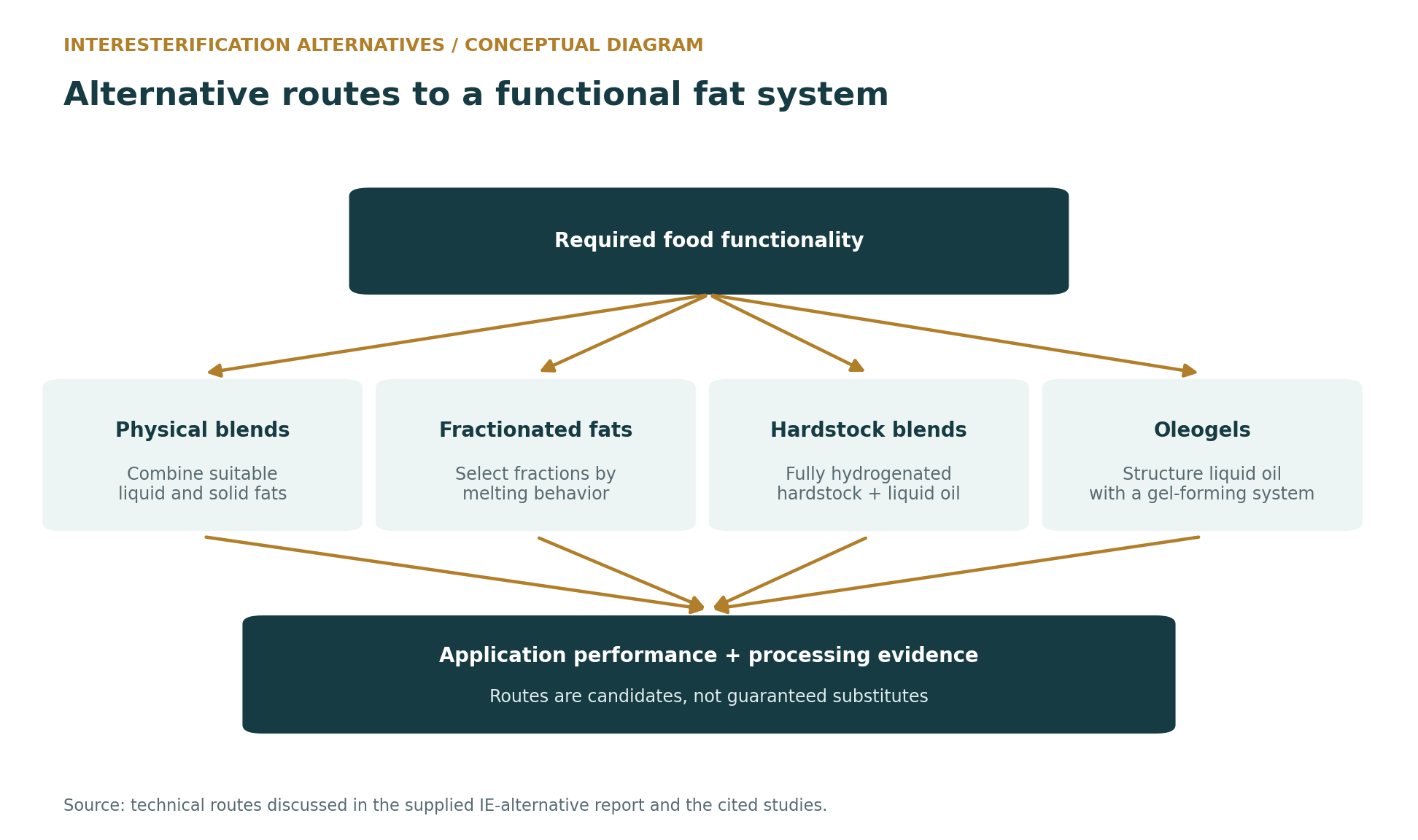
3. Candidate routes and their trade-offs
| Route | Potential role | Qualification question |
|---|---|---|
| Physical blending | Combine liquid oil and a documented non-IE hard fraction. | Does the blend deliver the required texture across the complete temperature range, including after storage? |
| Fractionated fat | Select fractions with different melting behavior, then blend as needed. | Are crystallization behavior, sensory melt and batch consistency suitable for the food? |
| Fully hydrogenated hardstock plus liquid oil | Supply a structuring component without a subsequent IE step. | Can cooling and shear produce an acceptable network without excessive hardness, graininess or waxiness? |
| Oleogel | Structure liquid oil using a gel-forming system. | Are the specific gelator, sensory properties, processing requirements and intended use acceptable? |
| Liquid high-oleic oil | Evaluate where the application does not require a plastic solid fat. | Is solid structure actually needed, and how does the finished food perform? |
Oleogels warrant targeted experimentation rather than a universal substitution claim. A cookie study investigated wax-based rice-bran-oil oleogels at several replacement ratios, demonstrating an application-specific experimental route.[3] That finding does not establish suitability for laminated pastry, whipped toppings or every jurisdiction. A gelled seed oil also remains seed-oil-derived: a change in physical structure does not change botanical origin.
Confectionery terminology requires similar care. Published studies have synthesized both cocoa butter equivalents and cocoa butter substitutes through enzymatic interesterification.[4][5] Neither category name proves the absence of IE. Technical resemblance to cocoa butter also does not establish eligibility for use in a legally defined chocolate product.
4. Application map: IE roles and alternative routes
The original report identifies seven application groups. Their processing histories cannot be inferred reliably from brand labels, so the map below describes candidate technologies rather than asserting that particular commercial products use or avoid IE.
| Application | Fat-system role | Alternative route and constraint |
|---|---|---|
| Margarine and spreads | Consistency, spreadability and temperature-dependent structure. | Direct blends of suitable fractionated hard fats and liquid oil; the complete emulsion and processing conditions determine suitability. |
| Peanut and nut-butter stabilizers | Limit oil separation through a small structuring fraction. | Documented non-IE hardstock systems may be candidates. The source's claim that the category is already predominantly non-IE is not established by labels. |
| Icings, fillings and biscuit creams | Consistency, sensory melt and oil retention. | Fractionated fats and physical blends; compatibility with other recipe fats and storage behavior must be assessed. |
| Whipped toppings and creamers | Provide the fat phase for emulsification and, where relevant, whipping. | Suitable lauric-fat or fully hydrogenated-fat blends; the word “hydrogenated” does not establish whether a later IE step occurred. |
| Compound and confectionery coatings | Melting, crystallization and coating performance. | Grade-specific fractionated or hydrogenated systems. Neither CBS nor CBE is inherently non-IE.[4][5] |
| Cake and all-purpose shortening | Plasticity, aeration and baked-product texture. | Fully hydrogenated hardstock plus liquid oil, or fractionated-fat blends. Direct blending is not automatically functionally equivalent to IE. |
| QSR and industrial frying | Oil performance during use and acceptable finished-food quality. | High-oleic liquid oils and appropriate blends. Confirm that the incumbent is IE before calling this an IE conversion opportunity. |
The source used well-known retail and industrial products to illustrate these categories. Their names are not evidence of a proprietary manufacturing route. A useful distinction is between an ingredient declaration, which may identify constituent oils, and a supplier process declaration for the exact fat grade, which can address whether interesterification was used.
5. Where the commercial opportunity is strongest
Bakery shortening. The original report prioritizes cake and all-purpose shortening because fat structure is central to performance and physical-blend alternatives provide a plausible development route. This remains a reasonable category to investigate, but neither category-wide IE prevalence nor performance parity is established. Cost advantages must be demonstrated for the particular formulation and line.
Spreads, icings and fillings. The report places these in a second group, where fractionated-fat blends may offer alternatives. Their appeal lies in established ingredient and blending options, tempered by the need to preserve consistency, sensory melt and storage behavior. Different temperature ranges and recipe fats can change the result.
Frying. High-oleic oils represent an adjacent performance opportunity. It is more accurate to frame this around required oil stability and food quality than to assume that frying is predominantly an IE conversion market. Published frying research also identifies sensory trade-offs.[6]
Stabilizers, toppings and coatings. The original report gives these lower conversion priority on the assumption that non-IE systems are already common. That ranking should remain provisional because the underlying manufacturing-route evidence was not supplied. Existing non-IE offerings could reduce conversion potential, but they could also offer a practical sourcing opportunity for customers with a documented restriction.
6. Market positioning, policy exposure and economics
The source report links interest in non-IE options to ingredient scrutiny and state-level labeling developments. Such developments can create customer requests even when technical requirements have not changed. A commercial offer should distinguish a customer's purchasing restriction from an enacted law, an enforcement position or a claim about health.
The original legal tracker discussed Texas, Louisiana and Utah alongside broader additive and processing debates. Its descriptions and injunction status were time-specific and are not presented here as a current legal determination. The enduring business question is whether maintaining an alternative formulation can serve a real customer requirement without creating unacceptable technical or sourcing costs.
Direct blending may avoid an IE processing step, but total economics also depend on hardstock price, fractionation yield, inventory, cooling and working capacity, rejects and finished-product performance. No reproducible contribution-margin calculation was supplied with the original report, so its strongest-margin assertions remain hypotheses. A non-IE formulation containing soybean, sunflower or canola oil is also not a seed-oil-free formulation; the two positioning claims must not be conflated.
For suppliers, flexible access to liquid oils, hardstocks and fractions can support several product briefs. The case for dedicated capacity is weaker when it depends on uncertain legal outcomes or unconfirmed assumptions about competitors' manufacturing processes. The report's opportunity thesis is therefore most useful at the level of specific applications and customer specifications.
7. Conclusions and limitations
Non-interesterified alternatives are technically diverse and commercially application-specific. Bakery shortening, spreads and fillings warrant investigation where customers seek a documented alternative route. Frying oils offer a related stability and sensory proposition, while stabilizers, toppings and coatings require better process evidence before conversion potential can be ranked.
This review retains the original report's technology and application analysis but does not validate market size, brand processing routes or finished-product equivalence. Published experiments demonstrate possibilities under particular conditions; they do not establish universal interchangeability. The opportunity is a fat system that meets an identifiable need, with an accurate description of how it was made.
References
- Zero trans fats from soybean oil and fully hydrogenated soybean oil: Physico-chemical properties and food applications. Food Research International (2009). Experimental study; accessible abstract.
- U.S. Food and Drug Administration. Final Determination Regarding Partially Hydrogenated Oils (Removing Trans Fat). Official regulatory resource.
- Physicochemical Properties and Cookie-Making Performance as Fat Replacer of Wax-Based Rice Bran Oil Oleogels. Gels (2023), 9(1), 13. Experimental study.
- Rhizomucor miehei lipase-catalysed synthesis of cocoa butter equivalent from palm mid-fraction and stearic acid: Characteristics and feasibility as cocoa butter alternative. Food Chemistry (2021). Experimental study; PubMed abstract.
- Production of Cocoa Butter Substitute via Enzymatic Interesterification of Fully Hydrogenated Palm Kernel Oil, Coconut Oil and Fully Hydrogenated Palm Stearin Blends. Experimental study (2022); PubMed record.
- Warner, K., & Gupta, M. (2005). Potato chip quality and frying oil stability of high oleic acid soybean oil. Journal of Food Science, 70(6), 395–400. USDA ARS publication record and technical abstract.