
Abstract
Heating history is central to frying-oil quality, but the conditions used to demonstrate deterioration determine the scope of the resulting conclusions. This expert commentary places a recent high-temperature study alongside the aldehyde literature discussed in Everyday Lipid’s earlier public-education review. The central distinction is between demonstrating chemical change under thermal stress and establishing performance, dietary exposure or health effects under practical use. A useful assessment should connect operating conditions with both primary and secondary oxidation measurements, validate findings in food-containing systems, and separate oil quality from nutritional outcomes. The recommendations below propose an application-based validation framework rather than dismissing severe-stress experiments.
1. Scope and study under discussion
Nandipeta and colleagues compared twelve cold-pressed/refined oils using 100 mL samples in open stainless-steel containers at 230 ± 5°C for 1, 2 and 4 hours. Their endpoints included fatty-acid composition, peroxide value (PV), conjugated dienes/trienes and other physicochemical properties. The authors relate the protocol to a street-vendor survey. Nine commercial units per oil were pooled into one composite; three batches per condition were independently heated. These are thermal replicates of a composite, not independent estimates of brand variation. The study acknowledges that aldehydes, total polar compounds and polymerized triacylglycerols were not measured. [1]
This is a critical narrative commentary, not a systematic review, meta-analysis or new experiment. It draws on the study above, selected primary investigations and operational guidance, with the author’s Cooking Oils, Heat and Health serving as a companion educational synthesis. [6] No datasets from different protocols are pooled, and no universal oil ranking or human risk estimate is calculated.
2. Agreement on chemistry does not establish agreement on exposure
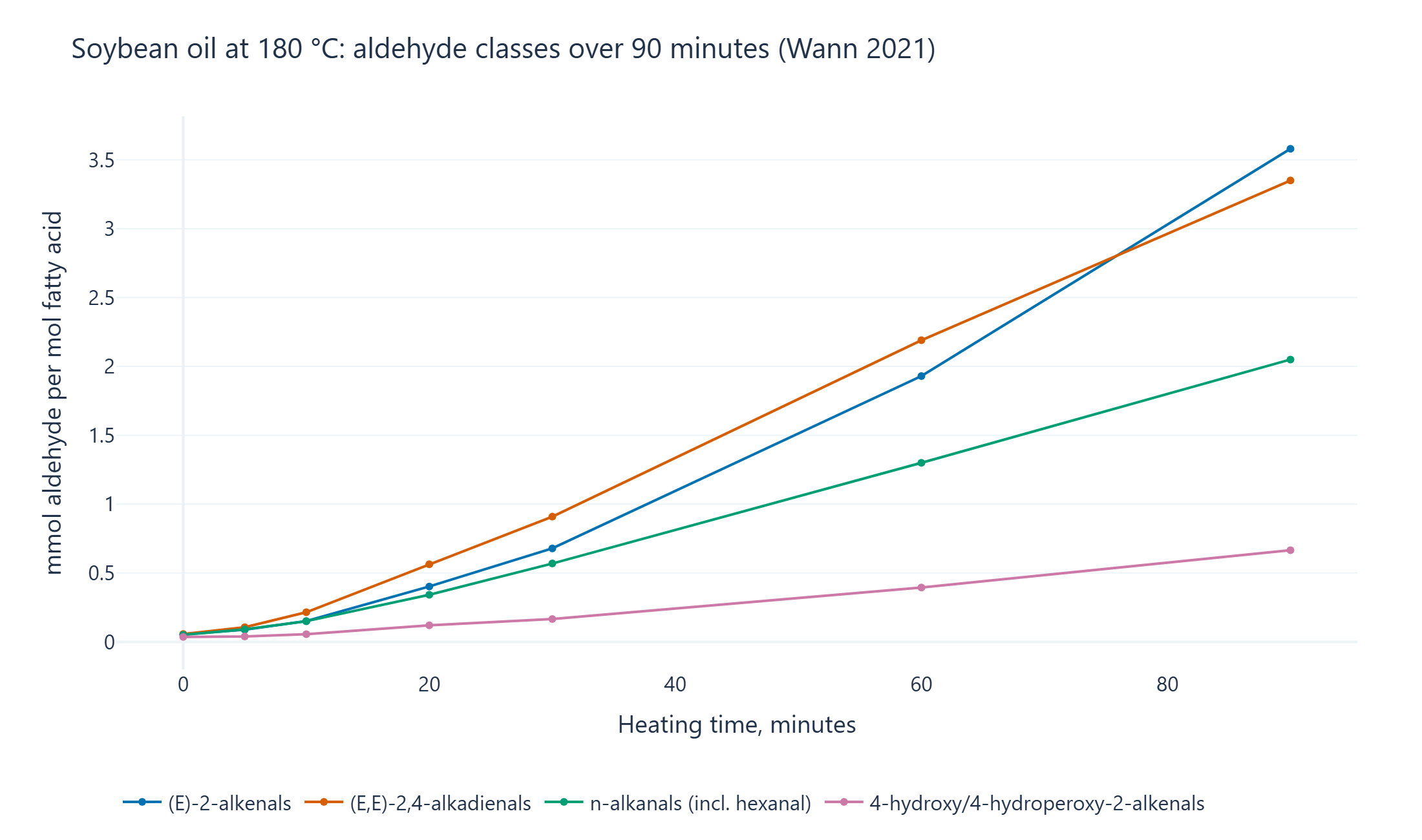
The earlier review discusses a sequence in which unsaturated lipids oxidize to hydroperoxides and then yield fragmentation products. Primary investigations using NMR have measured time-dependent aldehyde formation during laboratory heating. Wann et al. examined aldehyde profiles at 180°C, while Moumtaz et al. combined laboratory heating with repeated food-frying experiments. These studies support the existence of secondary oxidation and, in the latter case, transfer into food under the tested conditions. They do not establish that every fryer produces the same concentrations. [2,3]
Primary oxidation products→Aldehydes and other fragments
Secondary oxidation products
Figure 1. Simplified chemical pathway, synthesized for this commentary from the mechanism discussed in references 2 and 3. It omits parallel reactions and does not depict a measured rate or a human disease pathway.
PV is a snapshot of hydroperoxide accumulation, reflecting formation and decomposition rather than cumulative deterioration. Accordingly, a low or falling PV cannot alone establish that previously heated oil remains in good condition. Conjugated diene/triene measurements provide additional structural information; they do not identify or quantify individual aldehydes. Demonstrating the same broad degradation pathway is therefore different from reproducing a specific 4-HNE result. Targeted measurements are required for that claim. [2]
3. Temperature and time: distinguish the food from the oil
Food-service guidance describes 325–375°F, approximately 163–191°C, as a normal frying range, while recognizing some higher-temperature applications. It also describes prolonged operating periods, idle heating and replenishment. [4] In comparison, 230°C is 446°F. The issue is not whether every business uses one temperature, but whether conclusions have been validated for the particular operating range being discussed.
| Condition | Temperature | Interpretation |
|---|---|---|
| Food-service guidance range [4] | 325–375°F / ≈163–191°C | A reference range, not a universal legal or equipment limit. |
| Illustrative set point | 350°F / ≈177°C | Useful practical comparator; actual oil temperature changes with loading. |
| Study treatment [1] | 230 ± 5°C / 446 ± 9°F | Requires application-specific validation before generalization. |
A food portion may be immersed for minutes, but the oil can experience hours of heating across successive batches. Comparing a three-minute cooking cycle with a multi-hour oil experiment therefore confounds two different exposure times. A meaningful test records the full temperature history of the oil and its turnover, including preheating, recovery, idle periods and replenishment. [4] Short food residence time does not eliminate cumulative oil deterioration.
Likewise, open-air exposure is not itself an invalid design choice: many fryers are open. Oxygen delivery depends on the exposed surface, oil depth and interfacial behavior. Totani et al. demonstrated the importance of dissolved oxygen, cooling periods and interfaces during frying. [5] Adding food changes water input, bubbling, heat transfer and oil removal; it should not automatically be assumed to protect the oil or to worsen every measured endpoint.
4. Where the two publications agree—and where comparison stops
| Question | Companion review and cited literature | Interpretation for this commentary |
|---|---|---|
| Does thermal exposure degrade oil? | Discusses established primary and secondary oxidation pathways. | Broad chemical consistency is meaningful; it is not a validation of real-fryer exposure. |
| Are specific aldehydes demonstrated? | Includes studies using direct aldehyde measurements. | Do not infer individual aldehyde concentrations from PV or conjugation measurements. |
| Are numerical results interchangeable? | Includes different oils, methods, temperatures and durations. | Compare numbers only within appropriately matched protocols; avoid cross-study league tables. |
| Can an oil be called nutritionally superior? | Discusses chemistry and separates it from health evidence. | Thermal resistance is one performance property, not a complete dietary-health assessment. |
The same external-validity standard applies to the author’s earlier review. Its prolonged-heating experiments should be understood as evidence under stated conditions, not direct measurements of ordinary consumer intake. Strong comparisons acknowledge differences in initial oil quality, antioxidant systems, fatty-acid profiles and test geometry. These qualifications strengthen, rather than weaken, the case for managing oxidation in practice.
5. Why a universal temperature-doubling rule is insufficient
A Q10 assumption—that a reaction rate changes by a fixed factor per 10°C—can be useful for a defined reaction over a validated range. This commentary does not use it to convert severe heating into an equivalent number of restaurant operating hours. Frying comprises interacting formation, decomposition, volatilization and transport processes. Oxygen behavior itself changes with heating and cooling. [5] The temperature dependence of a selected chemical rate does not establish the same temperature dependence for the concentration remaining in oil or transferred into food.
Rate comparisons should specify the measured endpoint, establish a suitable kinetic model, and test whether that model remains applicable across temperatures. Extrapolation without this validation can create misleading precision. A larger temperature difference is a reason to investigate applicability, not a basis for an automatic numerical correction.
6. A proposed experiment that connects stress testing with application
The following framework is the author’s proposed design, not a published finding or a mandatory industry standard. A pilot should estimate variability and inform sample size before confirmatory testing.
| Design element | Proposed implementation | Question resolved |
|---|---|---|
| Temperature | Compare 170, 180 and 190°C with a separate 230°C stress arm; record actual bulk and local temperatures. | Do conclusions persist in the intended operating range? |
| Operating mode | Use matched oil-only heating, food-containing batch frying and a representative production schedule. | How much does the food/process system change the result? |
| Oil identity and replication | Test independent lots, retain lot-level data and characterize initial quality, fatty acids and declared additives. | Is variation attributable to oil grade, lot or treatment? |
| Geometry and turnover | Document surface-to-volume ratio, oil depth, food throughput, replenishment, filtration and idle/cooling periods. | Can a user reproduce or translate the protocol? |
| Sampling | Collect baseline and time-course samples across both batches and the operating day, using consistent cooling and storage procedures. | When do products appear, accumulate or disappear? |
| Quality endpoints | Combine PV/conjugation with suitable secondary-oxidation measurements, targeted aldehydes, total polar compounds, polymerized triacylglycerols and sensory assessment. | Are primary oxidation, fragmentation and cumulative deterioration aligned? |
| Exposure and product | Measure relevant products in oil and fried food; assess emissions separately where inhalation is in scope. | What reaches food or air, rather than merely forming in the vessel? |
Targeted carbonyl analysis should distinguish individual compounds such as 4-HNE, 4-HHE and acrolein from aggregate analytical signals. Methods need appropriate specificity, recovery, calibration and detection/quantification limits. Concentrations in oil, food and air must retain their separate units and denominators. Increased analytical coverage is useful only when the measurements answer the intended quality or exposure question.
7. Nutritional interpretation and conclusion
Four questions should remain separate: what chemical products form; how much reaches the food; what dose is absorbed or metabolized; and what health effect occurs. An oil-heating experiment addresses the first question most directly. Additional transfer measurements, exposure characterization and biological evidence are needed for the remaining steps. A lower concentration of one marker is not proof of an overall healthier diet, just as a greater laboratory oxidation response does not by itself establish disease risk.
The appropriate conclusion is conditional: severe thermal-stress testing can identify vulnerabilities and generate hypotheses, but application claims require validation under the operating conditions they are meant to describe. The practical response is to control overheating, define suitable oil specifications, monitor deterioration with more than one endpoint, and validate the complete frying system. Temperature, operating history and oil management should be assessed together.
References
- Nandipeta V, Chava SL, Mergu N, Rajendran A. Effect of continuous high thermal processing on physico-chemical and nutritional alterations in cold-pressed and refined edible oils. Frontiers in Nutrition. 2026;13:1949768. Published October 23, 2026. doi:10.3389/fnut.2026.1949768. Full text.
- Wann AI, Percival BC, Woodason K, Gibson M, Vincent S, Grootveld M. Comparative 1H NMR-Based Chemometric Evaluations of the Time-Dependent Generation of Aldehydic Lipid Oxidation Products in Culinary Oils Exposed to Laboratory-Simulated Shallow Frying Episodes: Differential Patterns Observed for Omega-3 Fatty Acid-Containing Soybean Oils. Foods. 2021;10(10):2481. doi:10.3390/foods10102481. Full text.
- Moumtaz S, Percival BC, Parmar D, Grootveld KL, Jansson P, Grootveld M. Toxic aldehyde generation in and food uptake from culinary oils during frying practices: peroxidative resistance of a monounsaturate-rich algae oil. Scientific Reports. 2019;9:4125. doi:10.1038/s41598-019-39767-1.
- Dunford N. Deep Fat Frying Basics for Food Services. Oklahoma State University Extension; March 2017. FAPC-126. Source. Accessed October 28, 2026. Operational reference, not a clinical study.
- Totani N, Yawata M, Mori T, Hammond EG. Oxygen Content and Oxidation in Frying Oil. Journal of Oleo Science. 2013;62(12):989–995. doi:10.5650/jos.62.989. Journal page.
- Everyday Lipid. Cooking Oils, Heat and Health: Aldehydes in heated oils, oil by oil—what has actually been measured. October 7, 2026. Companion review. Public-education synthesis, not an independent experimental dataset.
Article information and figure attribution
By Gil (Guang) Wang, Ph.D. Published October 28, 2026. Article type: expert critical review and commentary; not independently peer reviewed. This article presents the author’s interpretation and proposed validation framework. It reports no new experimental results and makes no claim of endorsement by the authors discussed, any employer, or a professional society.
The aldehyde chart is an existing author-supplied Everyday Lipid adaptation of the CC BY 4.0 source identified in its caption. Figure 1 is a simplified explanatory pathway prepared for this commentary. No artwork or quantitative dataset from the 2026 paper has been reproduced. Readers should consult the primary publications for experimental detail and uncertainty.