
VISUAL EXPLAINER
The molecular framework behind an oil blend
Blending
Combines existing oils and their triacylglycerol populations.
Interesterification
Rearranges acyl groups among or within glycerides; it does not itself create trans double bonds.
Fractionation
Separates fractions through differences in crystallization and melting behavior.
R₁, R₂ and R₃ are hydrocarbon chains attached through ester bonds. This is a generic triacylglycerol structure, not a specific commercial formulation.
Source: PubChem: example triacylglycerol
Abstract
The shortening and specialty-fat landscape is shaped by food functionality, changing ingredient preferences, sourcing requirements and raw-material economics. This report preserves the original analysis of North American and European opportunities for refining, blending and packaging, with particular attention to U.S. seed-oil and animal-fat positioning, EU traceability, and confectionery reformulation. Bakery shortening, frying fats and cocoa butter alternatives are treated as related but distinct markets. Source-report market estimates are retained separately from verified regulatory and technical findings. The analysis favors flexible, application-specific capabilities over a single substitute-fat strategy and highlights traceable supply and confectionery functionality as potential areas of differentiation.
1. Market overview and scope
The original July 2026 report examines shortening and bakery/confectionery fats from market structure through regional drivers, supplier activity, technology options, indicative sizing and refining/packaging implications. This publication preserves that sequence and commercial focus. Regulatory examples concern the United States and European Union; they should not be generalized to Canada or Mexico.
The source distinguishes conventional shortening from adjacent specialty fats, including structured blends, palm fractions and cocoa butter alternatives. That distinction matters because a bulk plastic fat and a specialized confectionery grade may have different pricing, qualification and processing requirements even when market reports combine them.
The study draws on public technical and regulatory sources and on commercial estimates cited in the source report. Estimates without a reproducible underlying dataset are identified as such. This is a narrative market and technical review, not a systematic review, audited market study or report of new experiments.
2. The post-PHO formulation landscape
The source identifies the removal of partially hydrogenated oils (PHOs) as the shared historical backdrop to modern fat reformulation. FDA's PHO determination and the EU trans-fat limit are distinct regulatory measures, but both are relevant to the transition away from PHO-based structuring.[2][3]
That transition brought greater attention to interesterification, fractionation, hardstock blending and high-oleic oils. These tools solve different problems. Experimental work on soybean-oil blends demonstrates that interesterification can alter physical functionality.[1] Liquid-oil selection, in contrast, is not by itself a replacement for the plastic structure required in some bakery applications.
Bakery fats may support aeration, dough handling, layered structure or filling consistency. Confectionery fats introduce melting, crystallization and compatibility requirements. Frying applications emphasize behavior during use and the quality of the fried food. The original report's opportunity map is most useful when these functions remain distinct.
3. North America and the EU: different market pressures
North America: consumer positioning and the tallow question
The source report describes a second reformulation discussion associated with the U.S. MAHA movement and scrutiny of seed oils. Its commercial thesis is that customer interest in butter or tallow can move faster than changes in manufacturing infrastructure. This is an interpretation of the market discussion in the July draft, not proof of a uniform industry shift or a nutritional advantage.
The report's “tallow gap” argument contrasts the scale of vegetable-oil use with the supply and pricing constraints of edible animal fats. It cites a contracting cattle base, competition for fats and increased attention to tallow-containing products. The precise herd, retail-sales and price figures are time-specific and have not been treated as verified current observations here. The underlying opportunity question remains whether premium animal-fat niches can be served economically, and what alternatives customers will actually accept.
The original conclusion favors flexible formulation and multi-feedstock capability over assuming that tallow can replace mainstream vegetable-oil demand. An important qualification is that a soy-, sunflower- or canola-containing blend cannot be sold as seed-oil-free merely because its processing or frying performance has changed. Food-versus-fuel competition also belongs in the supply analysis, but the combined food/feed/industrial category is not food-only demand.
European Union: traceability and confectionery economics
The source emphasizes traceable palm and soy supply and reformulation pressure associated with cocoa-butter costs. These provide different commercial incentives: sourcing documentation supports market access and customer requirements, whereas confectionery reformulation must preserve product identity and functionality. Price volatility may prompt interest in alternatives, but it does not establish that every substitute is technically or legally interchangeable.
United States. FDA determined that partially hydrogenated oils were no longer generally recognized as safe for use in food; the agency's resource explains the phased compliance history.[2] This is a defined regulatory foundation. Customer requests concerning seed oils, animal fats or processing methods should be assessed separately. A positioning preference does not establish improved nutritional quality, and a public announcement does not establish a binding requirement for every food category.
European Union. Regulation (EU) 2019/649 limits trans fat other than that naturally occurring in animal fat to 2 grams per 100 grams of fat in foods intended for the final consumer or retail supply. Its transition ended on 1 April 2021.[3] Product specifications should retain the exact scope of that rule rather than shorten it to an unqualified claim that all trans fat is prohibited.
Deforestation-related sourcing. The Commission lists EUDR application dates of 30 December 2026 for large and medium operators and 30 June 2027 for micro and small operators, with specified exceptions. Newly added products have a separate timetable.[4] For a particular fat or derivative, establish product scope and operator obligations before assigning a deadline. The sourcing opportunity is to provide reliable evidence for covered supply chains, not merely a general sustainability statement.
Certification model. RSPO distinguishes Identity Preserved, Segregated, Mass Balance and Credits/Book and Claim supply models.[5] “Certified” should therefore not be read automatically as physically segregated. Certification evidence and statutory due-diligence obligations are separate checks. Procurement should record the model actually purchased and whether its claims meet the customer's contract.
4. Confectionery fats: technical compatibility and product identity
Names such as cocoa butter equivalent (CBE) and cocoa butter substitute (CBS) are useful starting categories, but they do not replace a grade-specific compatibility assessment. Do not infer a non-interesterified route from either name: experimental literature includes enzymatic production of both types.[6][7] Ask the supplier for composition, intended use, processing requirements and compatibility limits.
EU Directive 2000/36/EC permits specified vegetable fats in certain chocolate categories up to 5% on its defined finished-product basis, while retaining minimum cocoa requirements and requiring additional labeling. Annex II restricts eligible fats to refining and/or fractionation and excludes enzymatic modification of their triglyceride structure.[8] This is not a general authorization to add any CBE or CBS to any product sold as chocolate. A technically successful experimental fat is not necessarily an eligible ingredient under that definition.
For development, evaluate the complete coating or chocolate system: recipe fats, filling contact, application temperature, cooling, storage cycling, sensory melt and appearance. The relevant commercial comparison is the cost and reliability of acceptable finished products. Ingredient savings alone are insufficient if a change adds downtime, rejects or designation constraints.
5. Supplier landscape and emerging technology
The original report surveys large integrated suppliers, specialty-fat businesses and bakery ingredient companies. The following table preserves that landscape as a set of participants identified in the source, without repeating unverified market-share rankings, corporate ownership assignments or product-launch claims.
| Companies identified | Role in the source analysis | Commercial question |
|---|---|---|
| AAK; Bunge Loders Croklaan | Specialty bakery and confectionery fat systems. | Which grade and technical service meet the customer's specific application? |
| Cargill; ADM | Broad oilseed, edible-oil and functional-fat capability. | How do oil selection, blending and supply scale support the required offer? |
| Wilmar; Fuji Oil; Musim Mas | Tropical oils, fractions and specialty-fat supply. | What sourcing documentation and grade-specific performance are available? |
| Stratas Foods; Ventura Foods | North American foodservice and industrial fat applications. | Which pack formats, distribution channels and customer services are relevant? |
| Vandemoortele; Puratos | Bakery ingredients and application development. | How is fat functionality integrated with the finished bakery product? |
The source's grouped references to Fuji Oil, IOI Loders Croklaan and Musim Mas should not be interpreted as a single company or ownership structure. Supplier listings indicate the report's market coverage, not a verified present-day corporate directory.
Oleogels. The report highlights structured liquid oils as a development pathway for selected bakery applications. Experimental cookie work evaluates particular wax-based oleogels and replacement ratios.[9] Such research supports further application development, not a universal replacement claim. Gelation also does not remove the botanical origin of the underlying oil.
6. Indicative market sizing from the source report
The original report quotes syndicated-market estimates to convey scale. The values below preserve that context but have not been independently reconciled with the underlying paid datasets. Definitions may differ across sources, especially for shortening, specialty bakery fats, CBE/CBS and total versus edible tallow. These figures should not be combined into a single market total.
| Metric | Original estimate | Period / qualification |
|---|---|---|
| Global shortening demand growth | 3.79% CAGR | 2026–2031 projection; exact source definition requires verification. |
| Europe's share of global shortening value | Approximately 35% | 2026 estimate, not a tonnage share. |
| Bakery/confectionery share of shortening applications | Approximately 50% | 2026 source estimate. |
| Plant-based share of shortening | Approximately 67% | 2026 source estimate. |
| Global beef-tallow market | $4.21 billion to $6.81 billion | 2025 to 2035 forecast; not necessarily edible-food-grade tallow alone. |
| CBE/CBS market value | $1.3–1.8 billion | 2025/2026 source range; category boundaries need reconciliation. |
| CBE/CBS growth | 4–6% CAGR | Mixed forecast horizons through 2030–2032. |
The report attributes its market sizing broadly to syndicated research publishers but does not provide the report identifiers, full definitions and calculations needed to establish these as investment-grade estimates. A precise error band would therefore imply more statistical support than is available. The figures are retained as context for the original argument rather than promoted as validated findings.
7. Regional comparison and refining/packaging opportunities
| Dimension | North American discussion | EU discussion |
|---|---|---|
| Customer pressure | Ingredient positioning, animal-fat interest and requests for alternative oil systems. | Sourcing evidence, product requirements and confectionery formulation economics. |
| Core constraint | Acceptable performance, supply scale, price and clarity of claims. | Applicable due diligence, traceability, legal product identity and performance. |
| Potential offer | Flexible blends, documented alternative processing routes, foodservice and niche pack formats. | Traceable supply, qualified bakery grades and appropriate confectionery fats. |
| Investment implication | Avoid a single-feedstock strategy justified only by short-term positioning. | Connect technical capacity to supply documentation and customer qualification. |
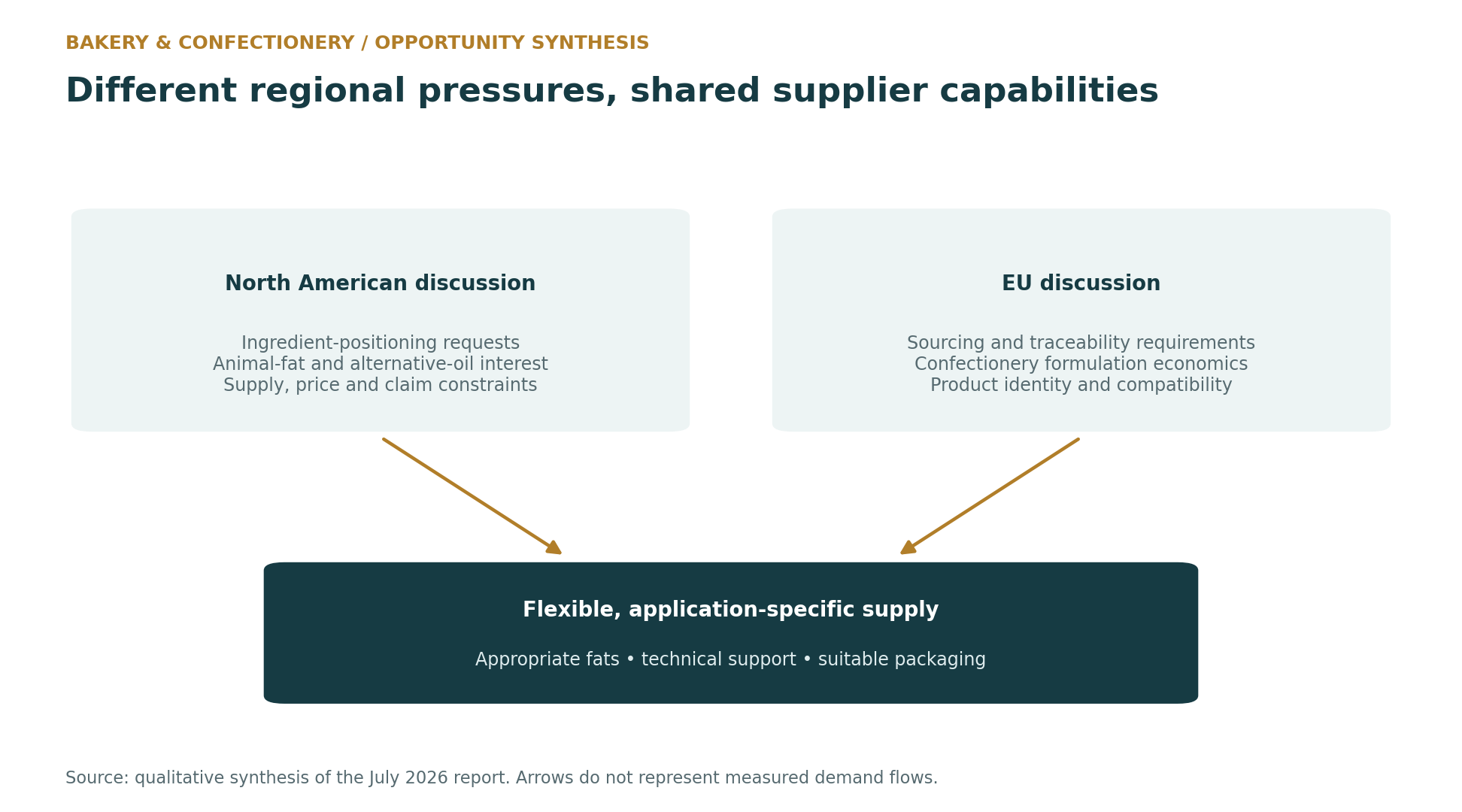
North America. The source favors serving specific reformulation requests rather than betting on wholesale replacement of seed oils by tallow. Flexible blending and access to multiple raw materials can support different briefs, provided the resulting product matches the claim and the customer's functional requirements. Premium foodservice opportunities and industrial volume opportunities should be assessed separately.
European Union. The report identifies sourcing documentation and confectionery expertise as potential differentiators. Traceability is not only a marketing feature where legal obligations apply. Similarly, a cocoa-butter alternative must satisfy both its technical brief and the applicable product definition; reducing ingredient cost alone is not sufficient.
Shared capabilities. Refining consistency, access to appropriate fractions and liquid oils, blending flexibility, temperature-controlled finishing and suitable packaging can serve several markets. The original thesis is that adaptable capability is more resilient than a single substitute-fat bet. The commercial case still depends on actual customers, grade specifications and achievable costs.
8. Regulatory tracker, limitations and conclusion
The source includes an addendum on Texas, Louisiana and Utah and broader U.S. additive-labeling and processing debates. Its specific enforcement dates, litigation statements and agency interpretations are time-sensitive and are not republished as a current legal tracker. Proposed rules, enacted laws, injunctions and customer preferences are different evidence categories. The original report also assigns some menu-disclosure discussion inconsistently across states; that attribution should not be relied upon without checking the governing text.
The report's principal limitations are heterogeneous market definitions, incomplete access to syndicated datasets, unverified company reformulation statements, and the gap between laboratory performance and commercial operation. Source-report estimates remain provisional. No particular supplier, product or plant is certified by this publication.
The original opportunity thesis remains: North American ingredient-positioning requests and EU sourcing and confectionery needs may create different routes to demand for specialized fats. A supplier can respond through flexible formulation, application expertise and reliable documentation. The most useful commercial assessment keeps raw-material availability, finished-food performance and market-access requirements connected without assuming that one alternative will serve every application.
References
- Zero trans fats from soybean oil and fully hydrogenated soybean oil: Physico-chemical properties and food applications. Food Research International (2009). Experimental study; accessible abstract.
- U.S. Food and Drug Administration. Final Determination Regarding Partially Hydrogenated Oils (Removing Trans Fat).
- European Commission (2019). Regulation (EU) 2019/649. Articles 1–4 and Annex.
- European Commission. Regulation on Deforestation-free Products. Official overview and application timetable, consulted 5 October 2026.
- Roundtable on Sustainable Palm Oil. Supply chains. Official definitions of the four supply models.
- Rhizomucor miehei lipase-catalysed synthesis of cocoa butter equivalent from palm mid-fraction and stearic acid: Characteristics and feasibility as cocoa butter alternative. Food Chemistry (2021); PubMed abstract.
- Production of Cocoa Butter Substitute via Enzymatic Interesterification of Fully Hydrogenated Palm Kernel Oil, Coconut Oil and Fully Hydrogenated Palm Stearin Blends. Experimental study (2022); PubMed record.
- European Parliament and Council (2000). Directive 2000/36/EC relating to cocoa and chocolate products intended for human consumption. Article 2 and Annex II.
- Physicochemical Properties and Cookie-Making Performance as Fat Replacer of Wax-Based Rice Bran Oil Oleogels. Gels (2023), 9(1), 13.